Uncover supply chain attacks with Baobab MDR Service

In summary: Attackers inject malware into an official, digitally signed software update. Traditional security solutions trust the signature and don't raise an alarm – the Baobab MDR Service still detects the attack because it monitors the software's behavior instead of just trusting its origin.
Who is this use case relevant for?
This scenario affects companies that:
- use software with extensive access rights– for example, for accounting, ERP, CRM, or remote maintenance
- allow automatic updates for this software without individually checking each installation
- are aware that their current security solution primarily checks, whether a software looks trustworthy – not, how it actually behaves
In short: Every mid-sized company that uses centrally managed standard software in automated update operations.
Attack overview
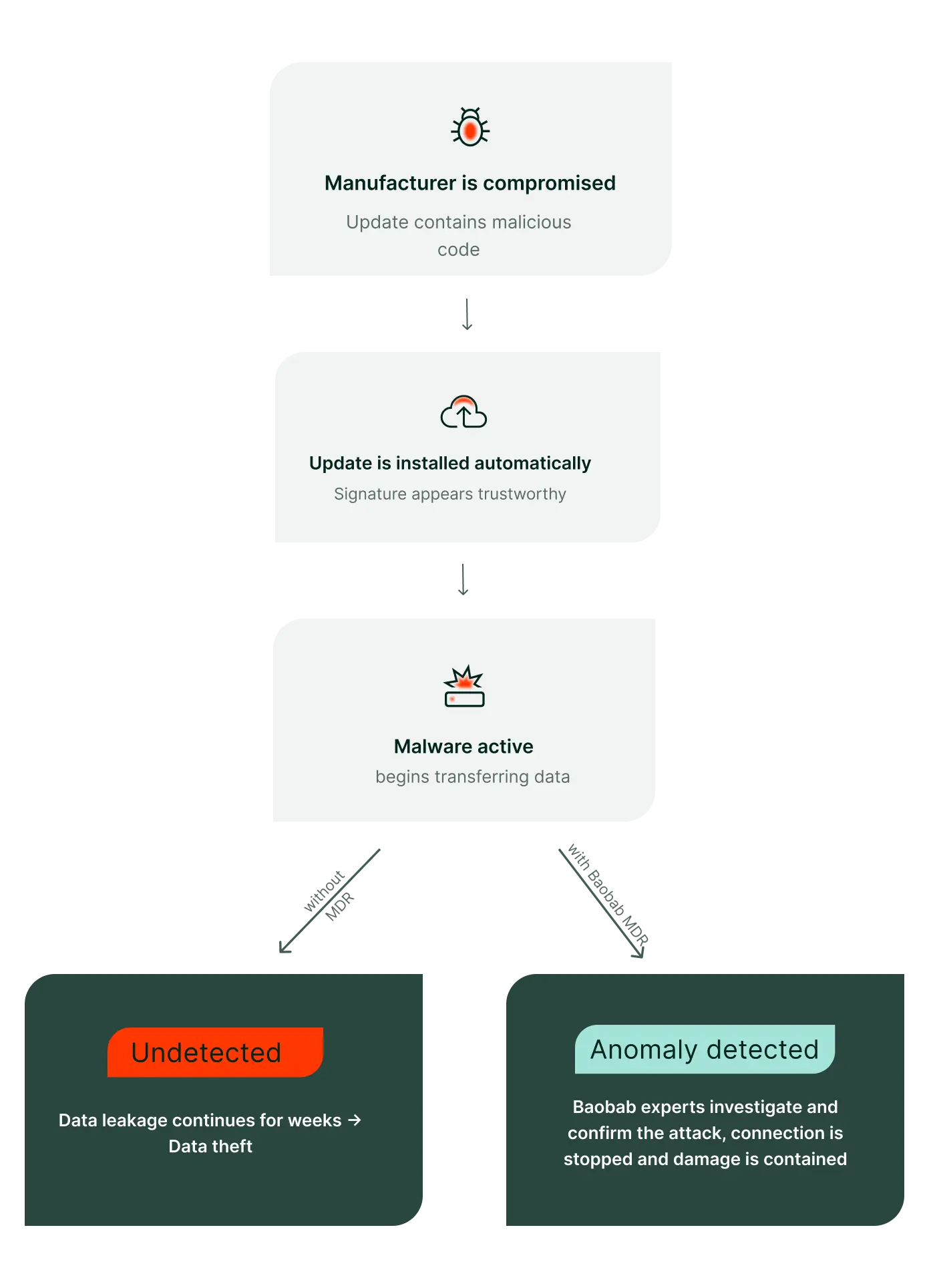
A software manufacturer becomes the victim of an attack. Hackers gain access to its development environment and inject malicious code into a regular update. The manufacturer signs and distributes the update as usual – unaware of the manipulation.
For the target company, everything appears normal: the update comes from a known source, bears a valid signature, and is installed automatically. In the background, the software then contacts an attacker's server and begins collecting and transmitting credentials and confidential documents.
Attack Flow: Without and With Baobab MDR
Consequences of such an attack
- Financial: For weeks, trade secrets, customer data, or intellectual property can be exfiltrated – directly harming competitive position and revenue
- Reputation: The loss of trust among customers and partners often outweighs the immediate financial damage
- Regulatory: In cases involving personal data, significant fines are an additional risk
Without Baobab MDR: Why traditional security solutions remain blind here
Traditional security solutions primarily check whether a file originates from a trusted source – i.e., if it's correctly signed and comes from a known manufacturer. This is precisely the case here, as the manufacturer itself was compromised. The software therefore receives a green light and can operate unhindered. The actual attack – the data exfiltration – thus remains unnoticed for weeks.
With Baobab MDR: How the attack is stopped
Baobab MDR does not rely on a software's origin, but continuously monitors how it normally behaves – and immediately detects deviations from it.
1. Detection: The software suddenly starts sending large amounts of data to unknown addresses abroad – a clear deviation from its usual behavior.
2. Verification: An analyst team evaluates the incident around the clock, cross-references it with other anomalies, and confirms: It is a real attack.
3. Response: Malicious connections are blocked, affected processes are stopped, and the manipulated update is isolated – before greater damage occurs.
Direct Comparison
| Without Baobab MDR | With Baobab MDR | |
|---|---|---|
| Verification Logic | Trusts the signature and origin | Verifies actual behavior |
| Detection | Benefits of Baobab MDR in this case
Protect your IT infrastructure from blind trust risks. Don't rely solely on digital signatures. Speak with our experts to learn how Baobab MDR effectively secures your supply chain.  FAQ 1. Why can't traditional antivirus scanners prevent a supply chain attack? They check files for known characteristics and trust certified manufacturers. If the manufacturer itself is compromised, the update is formally legitimate – the antivirus scanner won't raise an alarm. 2. How does Baobab MDR detect that an update is malicious? Not by its origin, but by its subsequent behavior: If software starts sending unusually large amounts of data to unknown addresses, this is classified as suspicious and investigated. 3. Does an infected update require the entire company network to be shut down? No. Usually, it's enough to block the affected connection or stop the affected process. The rest of the operations continue undisturbed. The blog post was written by |