Baobab MDR Service: Why Antivirus Protection Is Not Enough

As modern attackers rarely use traditional viruses anymore, conventional security measures are increasingly reaching their limits. To avoid operational disruptions and financial losses, companies are increasingly turning to Managed Detection and Response (MDR) services—a combination of AI-powered behavioral analysis and 24/7 expert oversight.
Record high in cyber damages According to Bitkom, the total annual damage caused by cyberattacks in Germany has risen to €202 billion over the past four years.
Why traditional antivirus protection is reaching its limits
Many companies still rely on traditional antivirus (AV) software. However, these work purely on a signature-based model: they compare files on a system against a database of known viruses. If a malicious file is not listed there, the protection fails.
The tactics of professional attackers, however, have fundamentally changed:
- Malware-free attacks: According to CrowdStrike, 82% of all attacks now no longer use traditional malware, but instead abuse legitimate system tools or stolen credentials.
- Identity theft: According to Palo Alto, attackers use stolen identities to gain unauthorized access to networks in 90% of cases.
- High speed of propagation: After the initial breach, it takes an attacker an average of just 29 minutes to spread throughout the entire corporate network, according to CrowdStrike.
- Increase in AI & zero-day vulnerabilities: According to CrowdStrike, the use of AI in attacks recently rose by 89%, while the exploitation of previously unknown security vulnerabilities (zero-day exploits) increased by 42%.
When attackers do not install viruses but instead use legitimate access points, classic antivirus systems remain ineffective. Therefore, technology is required that detects atypical behavior in real time and is monitored by experts who can intervene immediately in an emergency.
The synergy of EDR and MDR
To close the security gap created by modern attack patterns, a combination of advanced software and human analytical capacity is required:
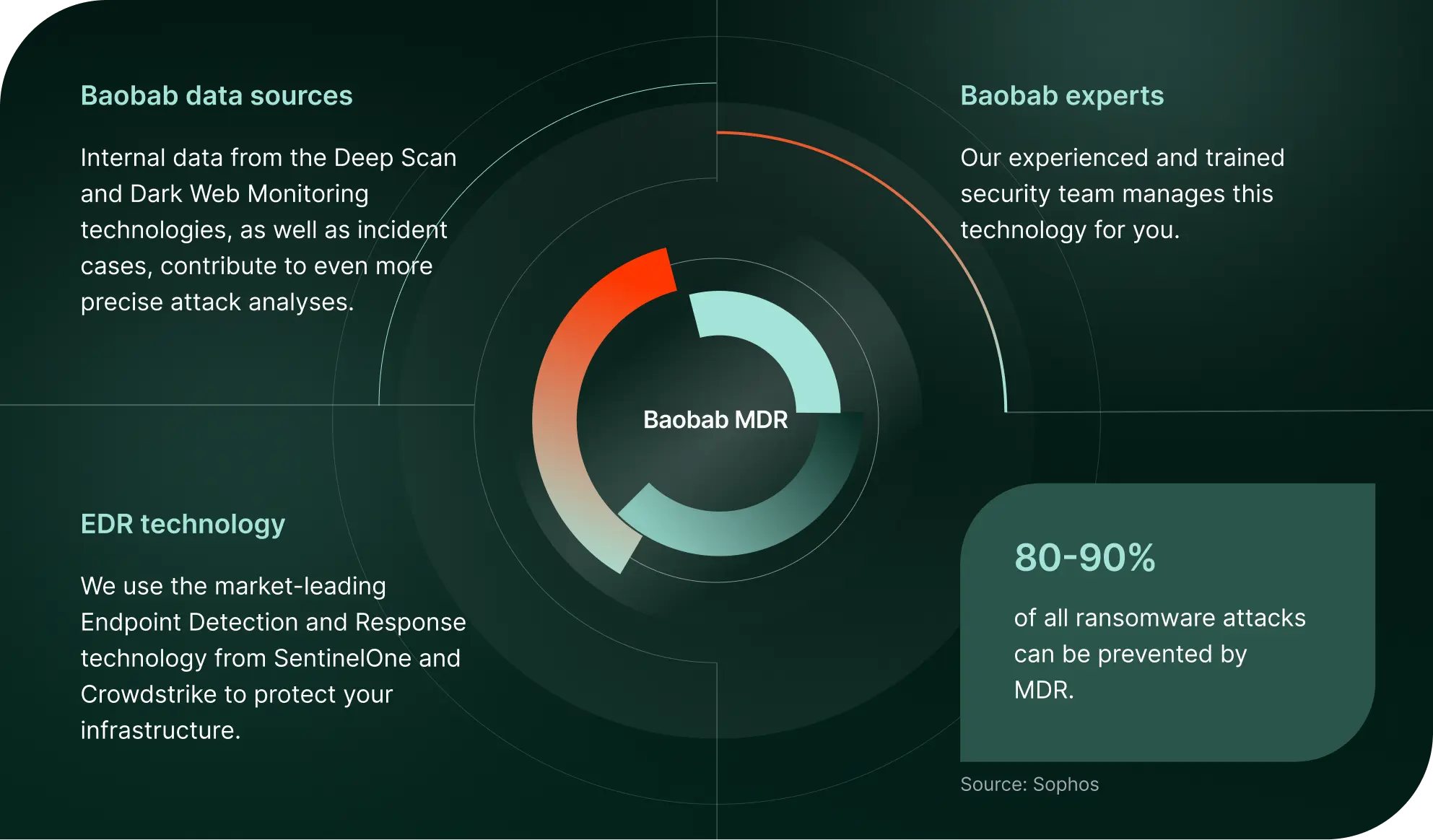
- Endpoint Detection & Response (EDR): EDR represents the technological evolution of antivirus protection. Instead of just looking for known virus signatures, EDR continuously analyzes all processes on endpoints. Through AI-powered behavioral analysis, suspicious patterns are detected immediately—for example, if an accounting account suddenly executes complex administrator commands or a system attempts to delete backups. Affected devices are automatically isolated to prevent further spread.
- Managed Detection and Response (MDR): While EDR provides the necessary technology, it is the human element that completes the protection. MDR describes the 24/7 operation of this technology by specialized analysts. They validate alerts, filter out false positives, proactively hunt for threats (Threat Hunting) and initiate immediate countermeasures in the event of an emergency.
The Baobab MDR Service as a holistic protective shield
In many companies, an overload of daily, often insignificant system alerts leads to severe strain on internal IT teams (Alert Fatigue). The Baobab MDR Service resolves this challenge by placing a trained, German-speaking security team in charge as a highly specialized filtering and analysis layer around the clock. Incoming signals from the EDR technology are not viewed in isolation: since 66% of investigations require more than one data source , the security experts enrich behavior-based analytics with exclusive context data from external vulnerability scans (Deep Scan), dark web monitoring, and insights from real-world insurance claims.
Through this precise data fusion, the security experts validate anomalies immediately and quietly filter out false alarms. The company's internal IT is completely relieved, receiving direct, clear notifications along with concrete recommendations for action only in the event of actual critical security incidents. At the same time, the security experts intervene immediately during an emergency through proactive threat hunting—isolating affected systems right away and actively stopping attacks before business interruptions or financial losses can occur.
Synergy between IT security and insurance
A demonstrably improved risk profile also has a positive impact on coverage. By using Baobab MDR, companies drastically reduce their risk of loss, which in practice is rewarded with cyber insurance premium discounts Cyber Safe as well as reduced deductibles.
Implementation requires hardly any internal IT resources: after a brief kick-off meeting and the installation of the software agents, our security team takes over continuous 24/7 monitoring.
Conclusion
The changing threat landscape requires a rethink of IT security. Traditional antivirus software is no longer sufficient against AI-powered, malware-free attacks. A modern MDR service closes this gap by combining behavior-based AI detection with the 24/7 expertise of seasoned cybersecurity professionals.
FAQ
What is the difference between EDR and MDR?
EDR (Endpoint Detection & Response) is the underlying software technology that analyzes processes on endpoints based on behavior and isolates suspicious activity. MDR (Managed Detection and Response) is the service that goes with it, where human experts monitor the EDR technology 24/7, filter out false positives, and take active measures in the event of an attack.
Does an MDR service replace the need for cyber insurance?
No, MDR and cyber insurance complement each other as part of a holistic security architecture. While MDR acts as a preventive layer of protection to stop attacks early and prevent operational downtime, cyber insurance covers remaining residual risks and financial consequential damages.
The blog post was written by