Stop Ransomware in Real-Time with Baobab MDR

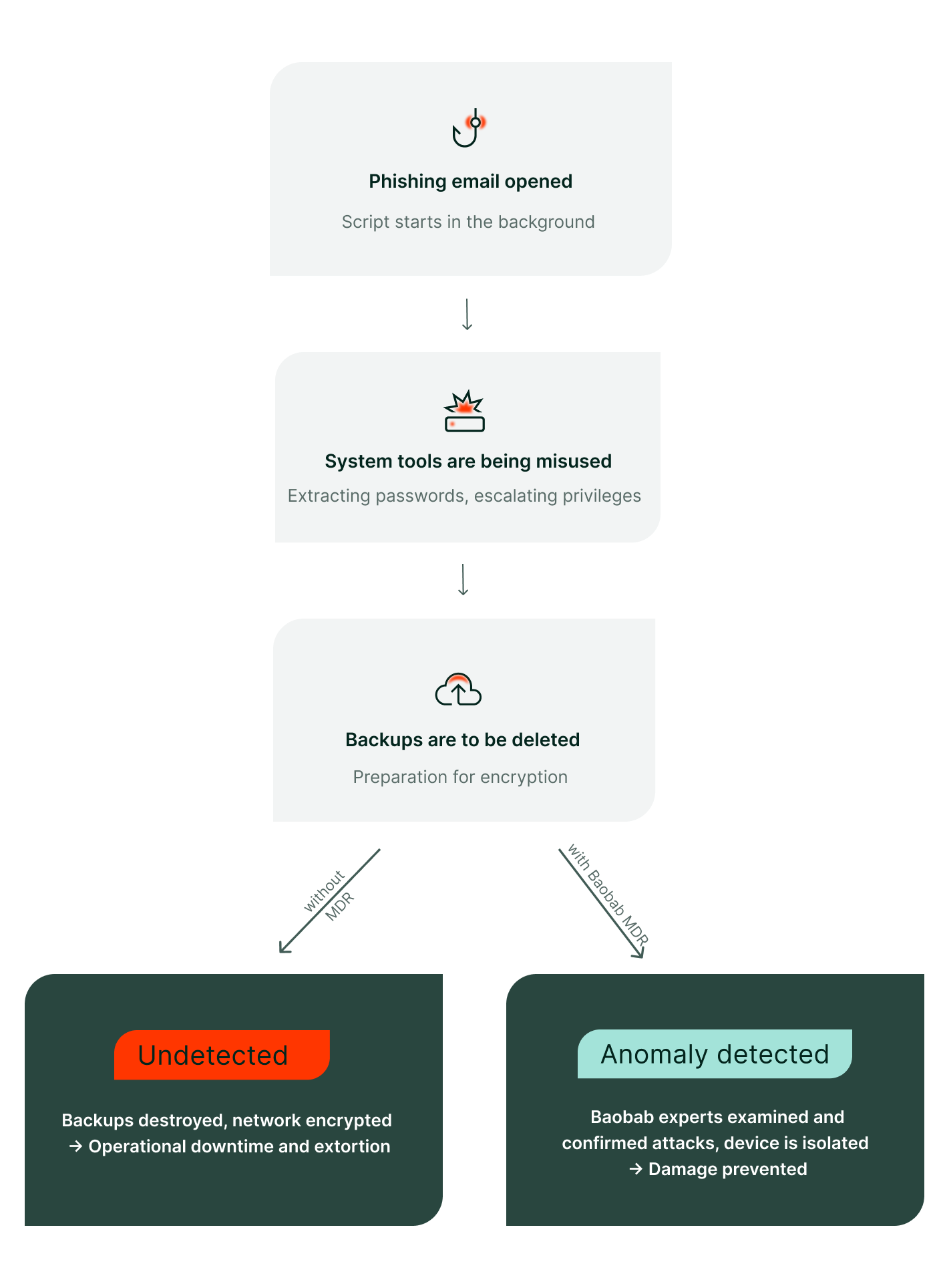
In summary: An employee opens a malicious email attachment. In the background, a script attempts to delete backups and spread across the network to prepare for later encryption. Traditional security solutions don't raise an alarm because normal, built-in system tools are being misused – the Baobab MDR Service still detects the attack because it recognizes unusual behavior and immediately isolates the affected device.
Who is this use case relevant for?
This scenario affects companies that:
- an internal IT department without its own 24/7 security monitoring have – meaning no one to respond to alarms at night or on weekends
- in an emergency, rely on working backups to restore operations
- wish to obtain or maintain cyber insurance and must demonstrate modern security measures for it
In short: Any mid-sized company with networked IT infrastructure and a lean internal IT department.
Attack overview
An employee opens a malicious email attachment during daily operations. A script launched in the background immediately attempts to destroy the company's recovery capabilities – specifically, to render existing backups unusable. For this, the attacker does not use traditional malware, but rather standard administrative tools built into Windows, to extract passwords and gain further privileges. With the stolen credentials, they then attempt to move deeper into the network – all the way to central server administration.
If this goes unnoticed, the actual ransomware attack follows: the complete encryption of all accessible systems, often combined with the theft of sensitive data for additional extortion.
Attack Process: Without and With Baobab MDR
Consequences of an Attack for the Company
- Financial: Without intact backups, the company faces weeks of production downtime and high costs for recovery or ransom demands.
- Reputation: Customers and partners lose trust, especially if data is also stolen and published.
- Time-Critical: After initial access, attackers often move through the network within minutes – every delay in detection significantly increases the damage.
Without Baobab MDR: Why Traditional Security Solutions Remain Blind Here
A traditional antivirus program searches for known malicious software. The problem: In this type of attack, mostly no classic malware instead, normal, typically harmless system tools are misused. To antivirus software, this looks like regular IT administration – no alarm is triggered. Additionally, lean internal IT departments often lack the tools to recognize individual, inconspicuous events as part of a connected attack chain.
With Baobab MDR: How the attack is stopped
Baobab MDR doesn't just trust a tool's inherent trustworthiness; it continuously monitors, how and in what context it is used – 24/7, including nights and weekends.
- Detection: The system detects that commands to delete backups are being executed – combined with an unusually disguised use of administrative tools. This is a clear warning sign.
- Investigation: An analyst team assesses the incident around the clock in its overall context: suspicious tool usage, attempted password theft, and backup deletion together paint a clear picture of an active attack.
- Response: The affected device is completely isolated from the rest of the network and from the attackers' servers within minutes. Malicious processes are terminated, compromised access is blocked, and suspicious files are moved to quarantine.
The Comparison
Baobab MDR: Giving Ransomware No Chance
- Detects attacks without classic malware: Responds to suspicious behavior, not just known virus patterns – exactly where traditional solutions remain blind
- 24/7 protection without your own security team: Nighttime or weekend attacks are detected, even if your internal IT team is unavailable
- Targeted rather than blanket response: Only the affected device is isolated – the rest of your business operations continue undisturbed
- Relief for your internal IT team: Defense runs in the background; your internal IT team receives concrete recommendations for final remediation afterwards, instead of nighttime alarms
Don't limit your digital risk to reactive measures. Speak with our experts to learn how Baobab MDR stops complex attack chains before your backups and operations are affected.

FAQ
- Why does Baobab MDR raise an alarm when only a standard system tool is being used?
What's crucial is not the tool itself, but the context of its use. If a regular workstation suddenly executes complex, obfuscated commands or establishes connections to unknown addresses, this is recognized as an anomaly.
- What happens to the data on the isolated computer?
Isolation only severs the network connection to prevent further spread or data exfiltration. The data on the hard drive remains unchanged and can then be forensically examined to determine the exact cause.
- What is the difference between the monitoring technology itself and the Baobab MDR service?
The monitoring technology automatically detects anomalies. Baobab MDR is the service built around it: Experienced analysts evaluate these anomalies around the clock, filter out false positives, and initiate countermeasures themselves in case of an emergency.
The blog post was written by